


ANNIVERSARY HOME PAGE
December 10, 1830 - May 15, 1886
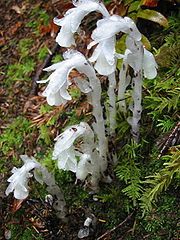
The Indian pipe (Monotropa uniflora), each stalk having a "once turned, single flower," featured on the Home page has another name "corpse plant" which must have dolefully amused the poet known for her preoccupation with death. Picking an Indian pipe, breaking the stem, turned it black, providing mysticism to the long, usually sunny outings of collecting plants and flowers. Ghostly, sometimes with a pink blush, growing in familial clumps of a few stalks. This waxen achlorophyllous plant inhabits shades deep in the forest, its nutrient the mychorrhizal fungus of tree roots, the spirit of the soil.
It was the "preferred flower of life" confided in a note of thanks to Mabel Loomis Todd who painted a picture of them to give the poet. Apparently unaware of this preference she may have observed the shared proclivities of flower and poet for primeval shade and sustenance.
Emily Dickinson, her uniqueness, right down to a white day-to-day garb and gradually reclusive, may have identified with this solitary little flower. A gel-like sap is said to have been used medicinally by the Wampanoags for remedying eye problems, a notoriously protracted one for the poet during two of the Civil War years (1860-1865 ) when she traveled to Boston for medical help.
In an 1873 paean to the end of winter, Emily Dickinson immortalized this bloom visible between June and September.
White as an Indian Pipe
Red as a Cardinal Flower
Fabulous as a Moon at Noon
February Hour -
Mabel Todd, who never met Emily Dickinson, transcribed poetry written in a miniscule hand from the hundreds of poems discovered after the poet's death, for her first and post-humous book of Poems.The fragile Indian pipe was embossed on the cover of the Roberts Brothers first edition published in November, 1890, a hundred and twenty years ago.
Marne Carmean July 2010
from Rule of Thirds
VIII
There can be little doubt that Jonathan Edward's Calvinist
heritage of the "infinite fullness of God", Emily Dickinson's
grandfather Samuel and his nurturing "powers" of nature
"to complete the circle of rational enjoyment. ("And here she has
prepared a banquet for reason."), the ever-present natural
"amphitheater" and pulchritude of her surroundings, converged
forming a plush poetic cortex, producing her images of a
banquet: food, wine, interlocking intoxication and numbness,
satiation and starvation, perimeters and infinity, a celestial,
circling, spicy, wheel of desire, distant and consummate,
"Circumference the Bride of Awe". (It is numbered 1620 in
the Johnson edition of The Complete Poems.)
The Rape and Recovery of Emily Dickinson,
In Her Words, Poems of Witness and Worth
An Autobiography of Emily Dickinson through Her Poems
ED
Emily Dickinson's grandfather Samuel's nurturing "powers"
of nature "to complete the circle of rational enjoyment."
was met by the poet with a quick and early formation in her
powers of observation and acute response to the natural
world. Those outdoor objects watched closely as a child in
the cozy environ of yard and field, later transmuted in her
poetry, such as seeing a branch of red apples as a Venetian
bedecked in rubies. The landscape of this orchard which
surrounded "The Old Homestead", the house where she
was born and died, as well as brother Austin's "Evergreens"
home next door, was subject to renovation this year.
(The "Evergreens" was designed by Austin but father
Edward Dickinson retained the deed.) The preservation
of the grounds of her muse as much as of this world
commenced in February of 2009, and was completed
on September 26, celebrated with a ribbon-cutting
ceremony, befittingly, the day of the annual marathon
reading of her 1789 poems. (There were only 1775
published in the historic 1951 The Complete Poems
of Belknap Press of the Harvard University Press,
edited by Thomas H. Johnson.)
Home to Austin and Susan Dickinson, brother and sister-in-law, the "Evergreens" was the first named house in Amherst. A hedge between it and "The Old Homestead" was maintained by the Dickinson's at the height of 6' - 10' which tolerated years of to-ing and fro-ing between the families as multitudinous notes and poems were passed by the poet and sister-in-law, with two hundred and seventy-six poems to Susan. The hemlock hedge of great age over a century old, overgrown and diseased, was removed in the renovation project. The stone steps up to "The Old Homestead" raised above Main Street were refortified. This first brick home in Amherst was built in 1813 by Samuel Fowler Dickinson, the poet's grandfather, and lost in bankruptcy repurchased twenty years later in 1855 by his son Edward.
 Home
Home